
Sustainable Lighting Solutions
For Commercial & Industrial Application
Powering Sustainable Facilities with Smart Lighting Solutions
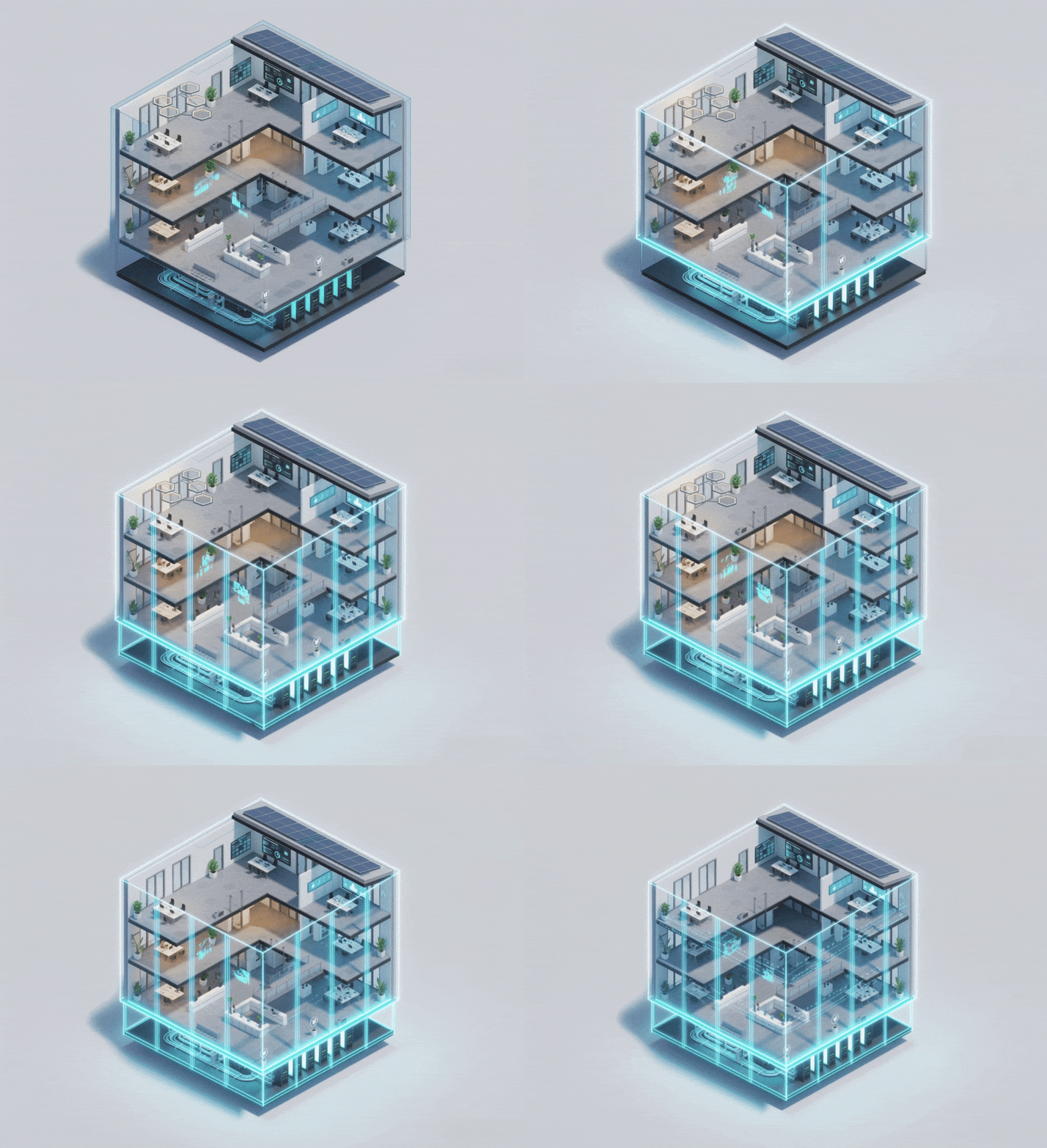
In today’s push towards sustainability, lighting is no longer just about illumination. It plays a key role in how facilities manage energy and operate efficiently. Our smart lighting solution integrates an AI enabled smart lighting system with energy efficient lighting, automatically adjusting to real usage patterns to reduce waste, improve overall efficiency, and deliver energy savings of up to 80% in optimal conditions.
Powered by Leading Smart Lighting Technologies
Built on a trusted ecosystem of leading lighting and control technologies, our smart lighting solution delivers reliable, scalable and energy efficient lighting for modern facilities.



Why Choose our Smart Lighting Solution?
Significant Energy Savings
High-efficiency LED lighting and intelligent controls help reduce unnecessary energy use and operating costs.
Lighting Design
Support for lighting layout planning, product selection and solution recommendations based on your project needs.
AI-Enabled Lighting Control
Intelligent sensing and automation adjust lighting according to occupancy, daylight and actual space usage.
Proven Across Diverse Applications
Suitable for offices, warehouses, car parks, corridors and other commercial or industrial spaces, for both new installations and retrofit projects.
Our Projects
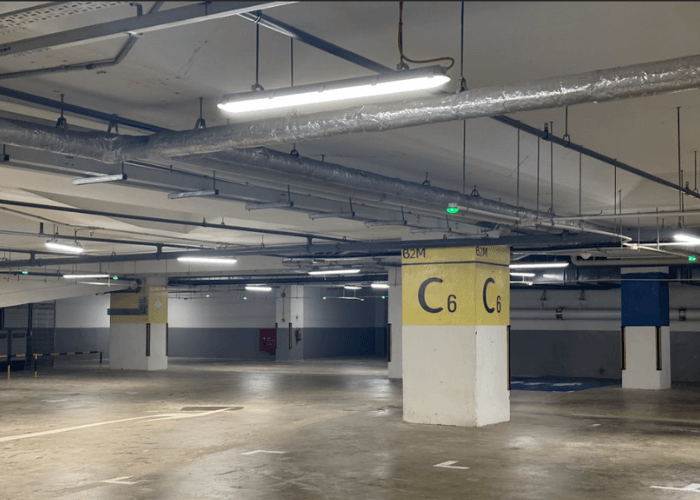
Smart Car Park Lighting @ Commercial Mall
Supply of lighting fixtures, testing & commissioning of smart lighting system
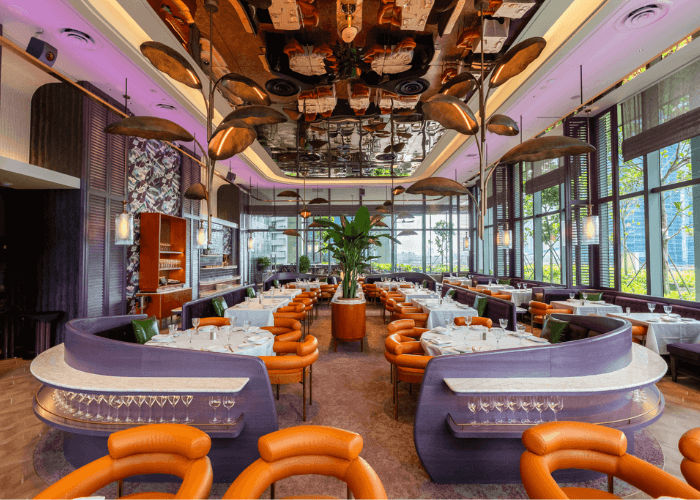
Smart Restaurant Lighting @ CBD
Testing & commissioning of smart lighting system
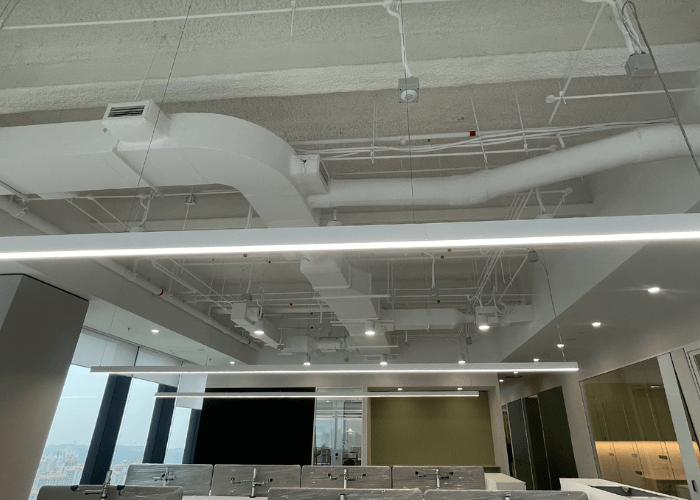
Smart Office Lighting @ Bugis
Supply of lighting fixtures, testing & commissioning of smart lighting system
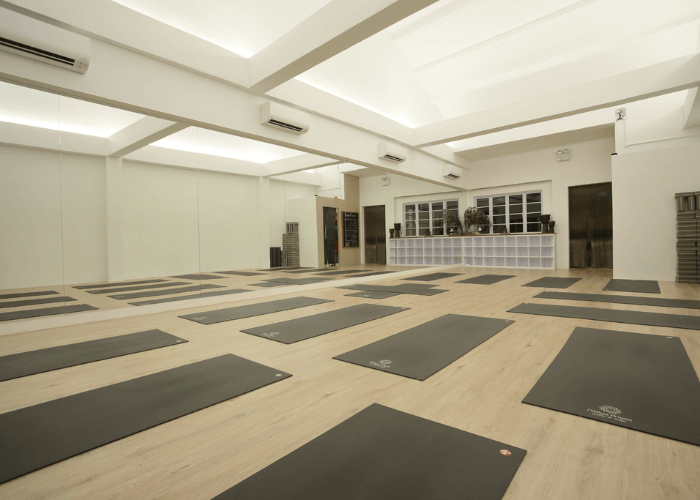
Smart Yoga Studio @ Chinatown
Supply of lighting fixtures, testing & commissioning of smart lighting system
Beyond Efficiency: Lighting That Anticipates Your Move

Our advanced smart lighting system is a comprehensive IoT ecosystem (Web Management + Mobile App + SaaS) designed for new and retrofit projects. Utilizing wireless Bluetooth Mesh, it offers a “Plug-And-Play” solution without the need for additional data cabling or complex rewiring. The system bridges the gap between safety and efficiency by maintaining a 10% safety glow instead of entering total darkness.
With AI-powered self-optimization and advanced IoT sensing, the system continuously adjusts lighting based on real-time conditions. Core lighting functions operate locally, ensuring reliable performance even during network disruptions.
Why Lim Kim Hai Electric for Smart Lighting
Feature
Typical Market Sensor Lights
Predictive Smart Lighting
Visibility
Safety Glow
Transition
Coverage
Intelligence
| Feature | Typical Market Sensor Lights | Predictive Smart Lighting |
| Visibility | Reactive: Lights typically trigger only after detection, often resulting in “sensor lag”. | Predictive IoT Linkage: Utilizes Bluetooth Mesh for millisecond-level response times and group linkage to illuminate paths in advance. |
| Safety Glow | Blackout Zones: Lights often turn completely off when no motion is detected, creating dark areas. | Companion Lighting: Automatically dims to a lower, preset brightness (e.g., 10%) rather than turning off, ensuring constant visibility and safety. |
| Transition | Sudden, jarring changes from 0% to 100% brightness. | Employs PWM control for seamless dimming and adjustable 2-step or 3-step brightness levels. |
| Coverage | Isolated Activation: Only the single fixture directly above the sensor reacts to movement. | Lighting Envelope: Uses IoT group control to create synchronized zones of light that move with the user across the entire area |
| Intelligence | Static: Operates on fixed sensor triggers without environmental awareness. | AI-Powered: Uses an algorithm that continually analyses and adapts to environment patterns and occupancy. |

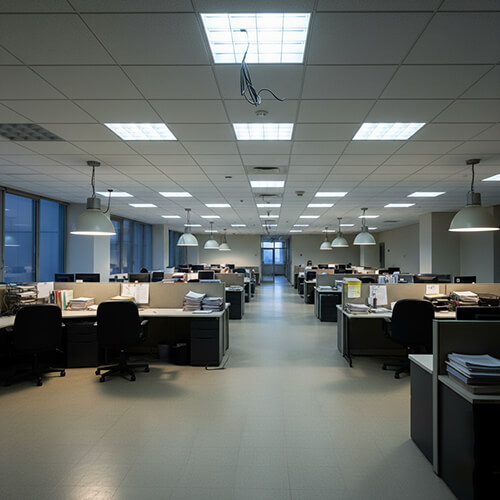
Retrofit Your Existing Facility with Zero Disruption
Many managers fear the downtime of rewiring. Our wireless smart lighting solution is ideal for retrofit projects because it requires minimal cabling and can be installed without disrupting day-to-day activities.
Achieve your sustainability goals faster by upgrading existing infrastructure into a flexible, scalable platform.
Benefits of Smart Lighting for Commerical & Industrial Spaces
Frequently Asked Questions (FAQ)
What is a Smart Lighting System?
A smart lighting system refers to wired and wireless controls over light fixtures for various purposes. A basic smart lighting system starts with a dimmable bulb, a connection module, communications protocol, and a controller. From here, color temperature, brightness, and even hue may be manually set, or pre-programmed with a smart device, such as a wireless control or a mobile phone.
To further build on a smart lighting system, it is possible to introduce sensors including motion sensors or daylight sensors. The smart lighting system becomes reactive to the external environment, automating scenes according to the sensors, timers, or both.
What are the different types of smart lighting systems?
Why should I consider installing a Smart Lighting System?
Smart lighting controls may serve many benefits to owners and occupants.
By installing a smart lighting system that employs energy efficient, dimmable LED lighting and sensors, owners cans save up to 70% on energy costs compared to conventional fluorescent lighting, without disruption of day to day activities.
Giving users more control over their environment can help to increase their satisfaction, comfort and productivity. By giving occupants control of their lighting, there is a perceived increase in control of their environment. Giving users control with a wireless smart lighting system is a way to improve wellbeing & address mental wellness in commercial, office, and industrial settings.
How can a smart lighting system help me achieve my sustainability goals?
Lighting makes up about 20% of a commercial building’s energy usage, which makes it an important area to touch on when discussing energy efficiency and energy savings. Using dimmable leds, timers, or motion sensors, it is possible to reduce lighting consumption onsite, while ensuring operations and functionality remain the same.
Is my facility suitable for a smart lighting system?
Smart lighting control systems are suitable for a wide range of applications including offices, commercial, industrial, and residential. Speak with our smart lighting specialist today to find what smart lighting system may best suit your needs.
What is the potential cost of installing an smart lighting system in Singapore?
The potential cost involved includes the cost of purchasing of light fixtures, smart lighting modules, installation, and switches or controls.
Lim Kim Hai Electric is a trusted supplier of smart lighting brands, and provides a complimentary on-site consultation. We are also offering the light fixtures, installation, system integration, and mainteannce as a one stop solution. We recommend engaging the Smart Lighting Specialist, Mr. Asher Chan, to advise the best solution that would fit your application needs, and therefore advise on the cost.
Can I install smart lighting in a retrofit project?
Yes, smart lighting that is fully wireless solution is actually most suitable for retrofit projects, because they reduce the amount of cable works & manual labor. This is due to the fact that the lighting control modules do not need to be wired back to the central distribution board. If you are looking for a solution that can be implemented quickly with minimal cable works, and offers flexibility and scalability, a wireless smart lighting solution may be the most suitable application for retrofit projects.
Are wireless smart lighting systems as reliable as wired systems?
Wireless systems can be just as reliable as wired systems. Bluetooth Low Energy (BLE) protocols such as Casambi, do not require wifi to perate, and they do not interfere with other bluetooth devices. In addition, Casambi creates a mesh network, meaning that modules communicate with one another via the best possible route, and if one node fails, the other node will carry on communicating around the failed node.
What lighting control protocols do your smart lighting systems support?
Our smart lighting solutions support a range of industry-standard lighting control technologies, including:
- DALI-2
- 0–10V / 1–10V
- Triac / Phase Cut
- Casambi wireless lighting control
Depending on project requirements, our solutions may also integrate with broader building automation and management systems through compatible gateways, controllers, or third-party integration platforms.
This enables scalable and interoperable smart lighting deployments for commercial, industrial, and architectural applications.
Let's work together