
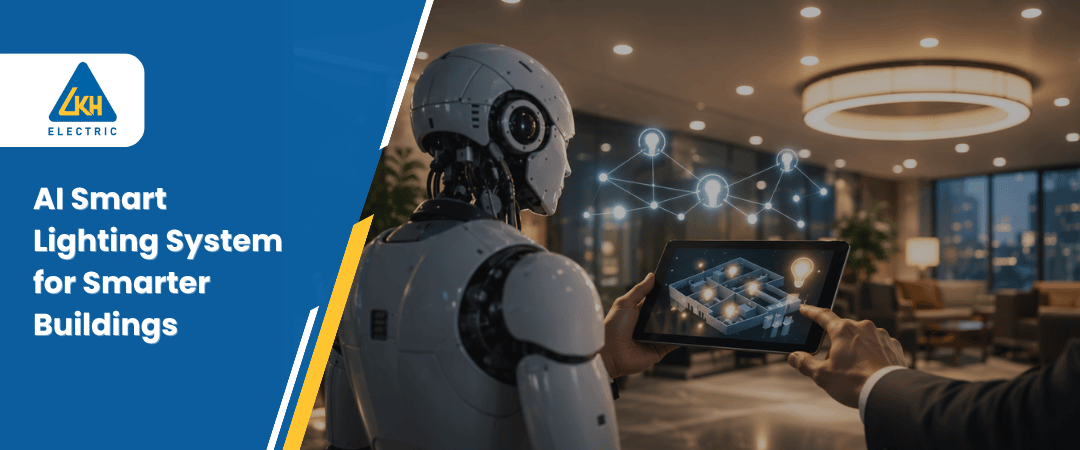
The lighting schedule says one thing. The building does another.
That gap is where energy waste, poor visibility, occupant complaints, and avoidable maintenance costs tend to build up. An ai smart lighting system addresses that problem by moving lighting control beyond fixed timers and manual switching. Instead of treating every hour, room, and usage pattern the same, it learns from occupancy, daylight, operational behavior, and site conditions to make better decisions in real time.
For commercial buildings, industrial sites, campuses, warehouses, and infrastructure environments, that shift matters. Lighting is no longer just a utility expense. It is part of a wider strategy around efficiency, safety, operational continuity, and carbon reduction.
What an AI smart lighting system actually does
At its core, an AI smart lighting system combines connected luminaires, sensors, controls, software, and analytics. The goal is not simply to turn lights on and off remotely. The real value comes from how the system interprets inputs and adjusts performance automatically.
A conventional setup might dim lights on a fixed schedule or respond to a basic occupancy sensor. An AI-enabled system goes further. It can identify recurring usage patterns, distinguish between transient and sustained occupancy, factor in available daylight, and recommend or apply lighting adjustments based on actual building behavior.
In an office, this may mean reducing overlighting in meeting rooms that are booked but not occupied. In a warehouse, it may mean increasing illumination in active picking zones while lowering output in low-traffic aisles. In a car park or common area, it may mean adapting light levels based on movement patterns, time of day, and security needs.
The difference is intelligence with context, not automation for its own sake.
Why businesses are moving beyond basic lighting controls
For many organizations, the first phase of lighting modernization was the LED upgrade. That still delivers meaningful savings, but it is often only part of the opportunity. Once LED efficiency gains are captured, controls become the next lever. AI adds another layer by improving how those controls respond over time.
This matters most in facilities where use is variable. Large offices, logistics sites, manufacturing spaces, educational campuses, healthcare buildings, and mixed-use developments rarely operate according to a perfectly predictable pattern. Occupancy shifts. Daylight changes. Production schedules move. Cleaning teams work after hours. Spaces get reconfigured.
Static control logic struggles in these environments. It can be too rigid, too conservative, or too dependent on manual overrides. An intelligent system helps close that gap by adapting to real operating conditions instead of forcing the site to fit a predefined schedule.
That usually translates into three outcomes decision-makers care about. Lower utility costs are the obvious one. Improved occupant experience is another, especially in shared commercial spaces. The third is better visibility into how the building actually runs, which supports both facilities management and sustainability reporting.
Where the biggest value shows up
The strongest business case for an ai smart lighting system tends to come from scale, complexity, or both.
In a single small site with stable hours, the return may be modest. In a multi-floor office, campus, warehouse network, hospital, or industrial facility, the gains are easier to justify because lighting behavior is harder to optimize manually.
Energy reduction is usually the headline benefit, but it is not the only one. Better zoning can reduce unnecessary lighting in underused areas. Continuous monitoring can surface failed drivers, abnormal energy consumption, or control faults earlier. Occupancy and usage data can also reveal whether certain areas are oversized, underutilized, or consistently active beyond planned hours.
That creates value beyond lighting. Facilities teams can align cleaning schedules, after-hours HVAC operation, and space planning with real patterns of use. Sustainability teams gain stronger operational data to support energy and carbon initiatives. Procurement and finance teams benefit from a clearer basis for lifecycle decisions rather than simply comparing fixture purchase costs.
AI smart lighting system design depends on the site
No two projects should be approached in exactly the same way. The right design depends on building type, operating hours, ceiling height, safety requirements, user behavior, existing electrical infrastructure, and integration goals.
An office project may prioritize occupant comfort, daylight harvesting, and room-level analytics. An industrial site may focus more on task visibility, hazardous area considerations, reliability, and reducing maintenance at height. A retail or public-facing environment may care most about customer experience, flexibility, and centralized control across multiple locations.
This is where many projects succeed or stall. If the system is specified as a generic smart lighting package, it may underperform. If it is designed around operational objectives from the start, it becomes a business tool rather than another building add-on.
A practical assessment usually starts with a few questions. What are the current energy and maintenance costs? Which spaces have unpredictable occupancy? Where are the recurring complaints or safety concerns? What level of visibility does the site team need? And does the organization want a standalone lighting system or one that can support broader building and sustainability initiatives over time?
Integration is where long-term value grows
A standalone lighting control system can still deliver savings. But the long-term upside increases when lighting is treated as part of a connected infrastructure strategy.
For example, integrating lighting data with energy monitoring can help teams identify which operational periods are driving excess load. Linking with building management platforms may improve scheduling coordination across HVAC, access control, and common-area services. In some environments, lighting data can also support occupancy-informed decisions around workspace utilization and after-hours operations.
That said, integration should be purposeful. Not every site needs every connection. More integration can also mean more planning, more stakeholder alignment, and tighter cybersecurity requirements. The right approach is often phased: establish a reliable lighting foundation first, then expand interoperability where it adds clear business value.
This is especially relevant for organizations balancing modernization with budget discipline. A phased rollout can target high-impact zones first, prove savings, and create a stronger case for broader deployment.
What to watch before you invest
The promise of intelligence can be overstated if the project basics are weak. Sensor placement, commissioning quality, user settings, and ongoing support still matter. A poorly configured smart system can frustrate occupants just as quickly as a manual one.
There is also a data question. AI-based recommendations are only as useful as the quality of the underlying inputs. If occupancy sensing is inconsistent or zones are not aligned with actual operations, the system may make poor adjustments or generate low-confidence insights.
Vendor selection matters for another reason: longevity. Buildings operate for years, often decades. Buyers should look beyond product features and ask about compatibility, support, maintenance, cybersecurity, firmware updates, and the ability to scale across sites. This is particularly important for commercial and industrial customers that cannot afford fragmented infrastructure or unsupported platforms.
A consultative partner can help here by matching controls, luminaires, sensors, and software to the operating environment rather than forcing a single product-led answer. For organizations planning wider efficiency upgrades, it also helps to work with a supplier that understands lighting within the broader context of energy management, procurement, safety, and sustainability.
How to evaluate an AI smart lighting system
The most effective evaluations focus on outcomes, not just specifications. Lux levels and connectivity protocols matter, but they are not the full decision.
Start with baseline performance. Understand current lighting energy use, maintenance frequency, user complaints, and any operational constraints. Then define what success looks like. That may be a targeted percentage reduction in lighting energy, fewer maintenance interventions, improved lighting quality in specific task areas, or better reporting for sustainability objectives.
After that, test the system against actual site conditions. Can it handle variable occupancy? Does it support local override where needed? How easily can facilities teams adjust settings? Will the analytics be useful to operations staff, or will they sit untouched in a dashboard? Can the system scale to additional zones or buildings without creating a new layer of complexity?
A pilot can be useful, particularly in sites with mixed-use spaces or multiple stakeholders. It allows teams to validate assumptions, refine settings, and build internal confidence before committing to a full rollout.
For many organizations, the strongest case is not just lower energy bills. It is the combination of measurable savings, better control, improved safety, and stronger alignment with carbon reduction targets. That is where an AI smart lighting system moves from a facilities upgrade to a strategic infrastructure decision.
As expectations around efficiency, compliance, and sustainability continue to rise, lighting will be judged less by whether it works and more by how intelligently it supports the building around it. The businesses that get ahead are usually the ones that treat that shift as an opportunity, not a retrofit line item.
Contact Us
Ready to make your lighting smarter?
Fill in the form to arrange a complimentary lighting site walk with our team. We will assess your current setup, identify potential improvement areas, and explore suitable smart lighting opportunities for your facility.